Words Are Weapons Too: Strategic Communication and the Costs of Silence in Operation Epic Fury
Strategic communication isn't a soft skill — it's a force multiplier, and incoherent messaging around Operation Epic Fury is costly.
COMMUNICATIONSSTRATEGYADVISORY
Matt Kavgian
3/20/202610 min read
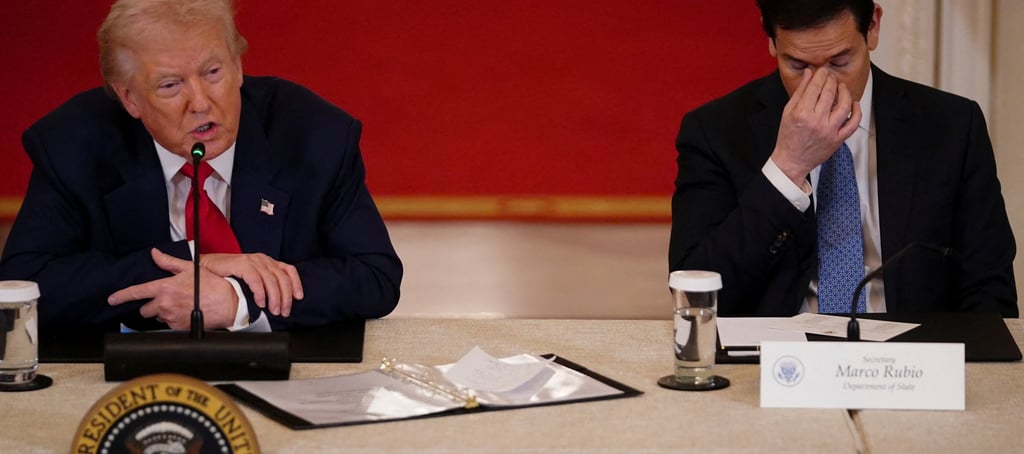
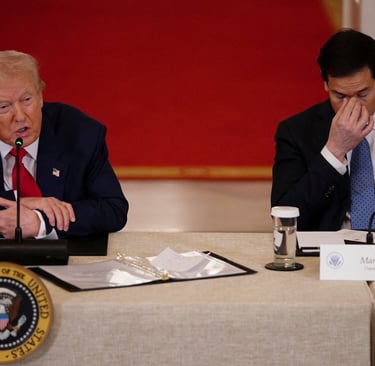
Photograph: Nathan Howard/Reuters
Let me be clear about what this essay is and what it is not. I broadly support the rationale behind Operation Epic Fury. Forty-seven years of persistent Iranian aggression, a nuclear program racing toward a breakout threshold, and a regime whose proxies have killed over a thousand Americans constitute a genuine and serious threat. Reasonable people can debate the precise timing and triggering intelligence, but the underlying case for confronting the Iranian regime militarily was not manufactured from nothing. I am not relitigating that decision here.
What I am arguing is that the Trump administration has handled the communication of this operation with a level of strategic incoherence that has real costs — costs measured not in moral abstractions but in coalition cohesion, domestic political sustainability, enemy exploitation, and the ability to define what "winning" actually looks like. These are not small concerns. They are the difference between a decisive strategic success and a conflict that outlasts its own purpose.
The Problem in Plain View
Within hours of the first strikes on February 28, 2026, the administration's messaging went off the rails. President Trump's opening address called on the Iranian people to take over their government when the bombs stopped falling — unambiguous regime-change language. The next day, he suggested in an ABC News interview that no one from Iran's previous leadership structure would fill the void because, he implied, they were all dead. Days later, administration officials were listing four distinct military objectives: destroy Iran's ballistic missile capability, annihilate its navy, sever its proxy networks, and deny it a nuclear weapon. These are not the same as regime change nor were they incompatible with the regime's survival.
The oscillation did not stop there. Trump hinted at ground troops, then walked it back. He spoke of "unconditional surrender," then suggested openness to negotiation. Press Secretary Karoline Leavitt repeatedly insisted the objectives were always clear and unchanged, even as the public record showed otherwise.
This pattern reflected what analysts have called "a bewildering array of war aims, contradictory statements, and no coherent vision for how the conflict would end" — a fluctuation between surgical strike logic and the total overthrow of the clerical regime, between behavior modification and regime replacement, without unifying strategic logic.
Iran's own leaders noticed. One Iranian commander publicly taunted: "I think they themselves do not even know what their ultimate objective is. Every day they talk about something different. Once about regime change, once about dividing Iran, once about the collapse of the government, and once about unconditional surrender." When your adversary can credibly mock your strategic coherence to his own people, you have handed him a gift.
Why This Matters: Three Dimensions of Strategic Communication
Internal Decision-Making and Leadership Alignment
Strategic communication is not merely a public relations function. It is the mechanism by which a commander-in-chief aligns his own national security apparatus — the Pentagon, the State Department, the intelligence community, theater commanders — around a common understanding of objectives, authorities, and end states. When that communication is absent or contradictory at the top, confusion cascades downward. And like an avalanche, once it starts, its all but impossible to stop.
The history of American military operations is littered with the wreckage of campaigns where unclear political guidance produced operational drift. Korea is the modern genesis case. President Truman's administration initially communicated a limited objective: restore the status quo ante and repel the North Korean invasion. That objective had broad allied support and reasonable domestic consensus. When General MacArthur pushed to the Yalu River without clear political authorization, and the administration failed to publicly reassert its limited aims, the operation's scope metastasized, China intervened, and a war that might have ended in 1950 dragged on for three more years. The disaster was not purely military. It was a failure to maintain alignment between political objectives and military operations, enforced through clear communication.
Vietnam offers another grim lesson. The Gulf of Tonkin Resolution gave Lyndon Johnson sweeping authority, but the administration never communicated to the American public, to Congress, or to its own commanders what success would look like. Was the goal to destroy the Viet Cong? Defend South Vietnam indefinitely? Force Hanoi to negotiate? The answers shifted with the political weather. Without defined end states, military leaders had no basis for recommending when enough was enough, and civilians had no basis for evaluating whether the war was being won. The result was escalation without purpose and withdrawal without victory.
Domestic Politics and Democratic Legitimacy
In a democracy, sustained military operations require a sustained public mandate. That mandate is built through honest, consistent communication of objectives, progress, and costs. It does not require perfection. It requires good faith.
The War Powers Resolution exists precisely because Congress and the American public recognized that undeclared wars fought on presidential authority alone are politically unsustainable and constitutionally questionable. When administrations communicate clearly about their aims — even limited aims — they build the political coalition that allows them to see operations through to completion. When they don't, they create a vacuum that opponents fill with their own narratives.
The most politically potent criticism of Operation Epic Fury has been that the administration has no endgame — and Trump's own rhetoric has not helped, feeding the impression of strategic incoherence. That criticism lands, not because it is fully fair, but because the administration created the opening for it. A president who cannot clearly articulate what he is trying to achieve and how he will know when he has achieved it will not sustain the political will to finish the job, particularly if the operation extends beyond its initial phase.
George H.W. Bush's conduct of the Gulf War in 1991 stands as the counterexample. He communicated a limited, achievable objective — expel Iraq from Kuwait — with relentless consistency. He built a 35-nation coalition around that objective. When Saddam Hussein was still in power after the ceasefire and critics clamored for a march to Baghdad, Bush held the line precisely because his stated objective had been achieved. That clarity was not a constraint on his flexibility. It was the source of his political legitimacy to stop.
International Relations and Coalition Cohesion
Allies need to understand what they are signing up for. When objectives shift, or are never clearly stated, allied governments face an impossible domestic politics problem: they cannot defend their participation in something whose purpose they cannot explain to their own parliaments.
European leaders declined President Trump's request to deploy additional naval forces to secure the Strait of Hormuz. That refusal did not occur in a vacuum. It reflects, at least in part, the difficulty allied governments faced in justifying participation in an operation whose aims had been publicly described as everything from nuclear non-proliferation to regime change. If the objective is stopping Iran from getting a nuclear weapon, that is a multilateral interest that can attract widespread support. If the objective is regime change in Tehran, the political calculus in Brussels, London, and Berlin looks very different. Through an economic lens, most allied governments will decline invitations to expensive open ended commitments.
The strategic communication failure did not go unnoticed by adversaries who benefit from American ambiguity. Chinese and Russian commentators interpreted the operation as a regime-change exercise using nuclear concerns as a pretext and assessed the Trump administration as strategically confused and divided. A confused America is a gift to Beijing and Moscow, who can use that confusion to position themselves as voices of stability and multilateral order while the United States appears to be acting unilaterally and incoherently.
The Three Uncomfortable Explanations
When an administration communicates strategic objectives this poorly, there are essentially three possible explanations, each with its own set of consequences.
Option A: The President considers strategic communication unimportant. This is the most charitable interpretation for the decision-making process, but the least forgiving for outcomes. If Trump simply doesn't prioritize the work of explaining American objectives to allies, the public, Congress, and adversaries, then the costs accumulate through inattention rather than design. Alliances fray because partners feel blindsided. Domestic support erodes because the case is never made. Adversaries fill the vacuum with their own narratives. This is not malice. It is neglect. But wars don't grade on effort.
Option B: The ambiguity is calculated. There is a school of thought — sometimes attributed to Trump's negotiating style, rooted in The Art of the Deal — or Kissinger’s mad man theory — that keeping options deliberately open, refusing to commit publicly to any single end state, preserves maximum flexibility and prevents adversaries from gaming American objectives. There is a kernel of truth in this. Operational surprise has value. Communicating targeting priorities in advance is obviously counterproductive. But there is a profound difference between tactical ambiguity about how you will achieve your objectives and strategic ambiguity about what your objectives are. The former can be a legitimate tool. The latter undermines the ability of your own commanders to make coherent decisions, destroys allied confidence, and provides adversaries with an ongoing propaganda gift. If the ambiguity is calculated, it has been miscalculated.
Option C: The President does not fully know himself. This is the most unsettling possibility, and the evidence is not flattering. The 2026 Iran conflict is being characterized by analysts as a campaign in which "success criteria are so vague as to be unverifiable" — a conflict where political objectives were defined after the shooting started rather than before, reversing the basic Clausewitzian logic of war as an instrument of policy. A president who invites the Iranian people to take over their government in his opening address, then neither commits the resources for regime change nor articulates what short of regime change would satisfy American objectives, may simply be improvising. And improvisation is not a strategy.
The Fog of War Is Real — and It Is Not the Whole Story
None of this is naive to the genuine complexities of military operations. The fog of war is real. Intelligence is imperfect. Situations evolve in ways that require adapting stated objectives. The enemy gets a vote. The possibility that imminent intelligence accelerated the timeline of Operation Epic Fury, compressing normal interagency deliberation about communication strategy, deserves honest acknowledgment.
It is also possible that some operational details require deliberate opacity, that certain endgame scenarios must remain unstated to preserve leverage, and that the administration has a more coherent internal strategy than it has communicated publicly. The tactical execution of Epic Fury, whatever one thinks of its political communication, has been described by military observers as sophisticated and effective.
But these caveats have limits. The fog of war explains unclear communication in the first 48 hours. It does not explain three weeks of contradictory statements about whether the objective is nuclear non-proliferation, regime decapitation, popular uprising, unconditional surrender, or negotiated settlement. The fog of war explains why you cannot reveal exactly what targets come next. It does not explain why you cannot maintain consistent language about what victory looks like in political terms.
The ongoing absence of clarity is a choice, not a condition imposed by circumstances.
The Historical Pattern and What It Costs
The pattern is not new, and history is not encouraging about where it leads. The lesson of every protracted American military engagement since Korea is that operations begun without clearly communicated, achievable political objectives tend to expand until they consume their own rationale.
In Afghanistan, the George W. Bush administration began with a clear and achievable objective: destroy Al-Qaeda's operational base and remove the Taliban government that hosted it. That objective commanded overwhelming domestic and international support. But the administration never clearly communicated what came next. When the Taliban fell and Bin Laden escaped to Pakistan, the mission gradually transformed into something far more ambitious — democratic nation-building in one of the least hospitable environments on earth — without anyone clearly articulating that the objective had changed. The result was twenty years of conflict, trillions of dollars, and a withdrawal that left the Taliban back in power.
The Bush 43 administration's conduct of the Iraq War's aftermath offers the starkest warning for Operation Epic Fury. "Mission Accomplished" was not merely a premature celebration. It was a symptom of a deeper failure to communicate — honestly, consistently, and publicly — what the actual mission was after major combat operations ended. The vacuum created by that failure was filled by sectarian conflict, Iranian proxy influence, and an insurgency that lasted for years. If the Trump administration successfully degrades Iran's military capabilities without a coherent plan for what follows — communicated clearly to the Iranian people, to regional partners, to Congress, and to the American public — it risks creating a similar vacuum.
Some analysts have already noted that the United States appears to be prosecuting the war with primarily one instrument of national power — military force. After all, we do it very well and are quite enamored with our capabilities. The problem is we tend to get high on our own supply and forget that the other tools of statecraft are equally – if not collectively more – important. Iran is deploying all five, including diplomatic, informational, economic, and legal tools. An adversary that can compete effectively on non-military dimensions while absorbing military losses is not a defeated adversary. It is an adversary waiting for American political will to exhaust itself.
What Good Strategic Communication Looks Like
This is not an argument for unlimited transparency about operational details or for revealing intelligence sources and methods. It is an argument for consistent, honest communication of political objectives — the why and when we'll know we're done, even if not the exactly how.
Franklin Roosevelt's "Germany First" strategy in World War II was communicated clearly enough that allied governments could align their planning around it. The specific operational plans for D-Day were kept secret. The political objective was not.
Reagan's strategic communication about the Cold War was relentlessly consistent. The objective was to pressure the Soviet system until it reformed or collapsed. That consistency sustained political support for a decades-long competition. It did not require revealing intelligence assessments or operational details.
Bush 41's Gulf War communication, already noted, defined what success looked like before the first shot was fired. That definition allowed the coalition to hold, the war to end when its objectives were achieved, and the president to resist pressure to overshoot.
The standard is not perfection. The standard is consistency, honesty about what is known and unknown, and a genuine attempt to bring the American public, Congress, and allies into the strategic reasoning — even if not into operational planning.
A Final Word
The men and women executing Operation Epic Fury deserve leadership that gives their sacrifice strategic meaning by being clear about what they are being asked to accomplish. The American public, which is bearing the costs of this operation in treasure and risk, deserves to know what success looks like. The allies who might stand with the United States deserve confidence that the objectives they are asked to support will not shift beneath them. And the adversaries the United States is trying to deter deserve to understand clearly what American resolve demands of them.
Strategic communication is not a soft skill. It is a force multiplier. The failure to practice it is not a stylistic choice with minor consequences. It is a strategic error with compounding costs.
The operation may yet succeed militarily. But strategic success requires more than military effectiveness. It requires the political will to sustain the mission, the allied support to share its burdens, and the defined end states that tell everyone — including the enemy — when it is over. None of those things are possible without clear, consistent, honest communication of what America is fighting for and what it will take to stop.
That is the part this administration has not yet gotten right. And it matters.
© 2025. All rights reserved.